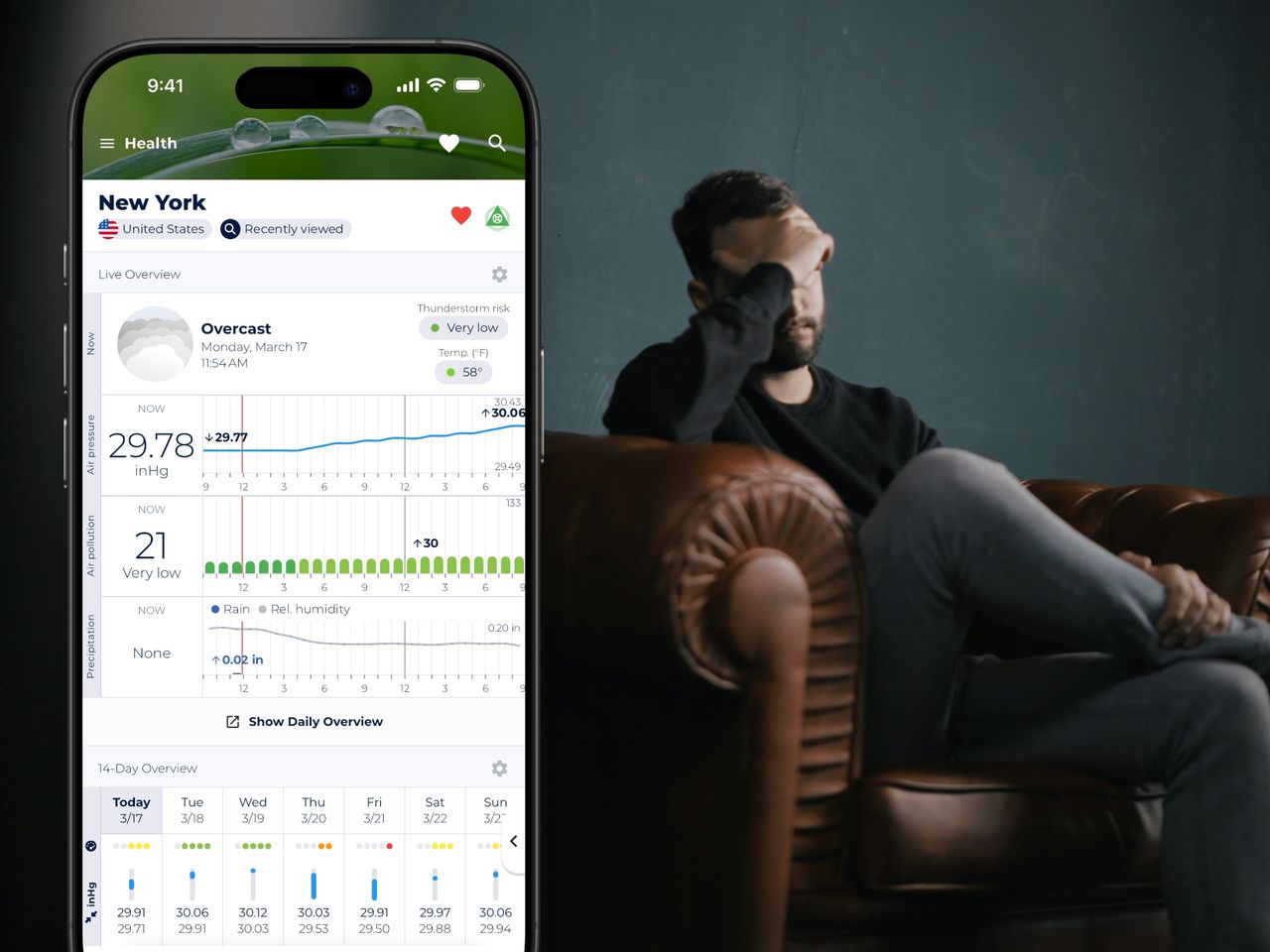
A migraine weather forecast shows the weather changes linked to headaches (falling barometric pressure, temperature swings, humidity and thunderstorms) so you can see likely trigger days before a headache starts. In one headache clinic study, about half of the migraine patients turned out to be sensitive to the weather. [1] There’s no single pressure level that triggers migraines, so it helps to watch the trend over hours and days. [8] [9]
Sonuby Weather’s Health Report is a free migraine weather forecast for iOS and Android: an hourly barometric pressure graph for the next 24 hours, a 14-day pressure outlook, and thunderstorm, temperature and air-quality forecasts in one place.
If your head tends to know about a storm before the sky does, here’s what the research says and how to plan around it.
In this article:
Sonuby Weather’s Health Report provides 24-hour and 14-day barometric pressure forecasts, thunderstorm forecasts, and temperature tracking — everything you need to predict weather-triggered migraines and headaches before they start.


If you’ve ever felt a migraine coming when storm clouds gather or a cold front moves in, you’re not imagining things. In one headache clinic study, about half of the migraine patients (39 of 77) turned out to be sensitive to the weather, though even more of them, 62%, believed they were. [1]
Weather-triggered headaches fall into several categories:
Migraines: Severe, throbbing headaches often accompanied by nausea, light sensitivity, and visual disturbances. Weather changes can trigger migraine attacks in susceptible individuals.
Sinus Headaches: Pain and pressure around the sinuses (forehead, cheeks, and bridge of nose). Most people who think they have sinus headaches actually have migraine: in a study of 100 people with self-diagnosed sinus headaches, 86 had migraine or probable migraine, and only 3 had a headache caused by their sinuses. In that study, 83% named weather changes as a migraine trigger. [12] A study of nearly 3,000 people with a history of “sinus” headaches found much the same: 88% met the criteria for migraine or a migraine-type headache. [13]
Tension Headaches: While less directly weather-related, these can be triggered by weather-induced stress, poor sleep during storms, or changes in daily routines due to weather.
The good news? Once you understand your specific weather triggers, you can use a migraine weather forecast to anticipate problem days and take preventive action. And because most self-diagnosed “sinus headaches” are migraines [12] [13], a migraine weather forecast can help with those too.
Barometric pressure — also called atmospheric pressure or air pressure — is the weight of the air pressing down on Earth’s surface. This pressure isn’t constant; it fluctuates based on weather systems, with high-pressure systems bringing clear skies and low-pressure systems often bringing clouds and storms.
Why a drop in pressure sets off a headache isn’t settled yet. One leading idea is that pressure changes may activate the trigeminal nerve, a key player in migraine pain. [2]
The research on pressure and headaches is mixed. In a study of 7,054 people who went to an emergency department with a headache, lower pressure in the two to three days before came with a small rise in risk, mostly for headaches other than migraine, and higher temperature mattered more. [3] Smaller studies of people with migraine found more attacks around day-to-day drops of more than 5 hPa [8], or when pressure sat 6–10 hPa below the standard 1013 hPa. [9]
This is why a migraine forecast today is so valuable — you need to track pressure trends over time, not just a single daily number.
A day that looks “fine” on a standard weather app might include pressure changes that spell trouble for headache sufferers.
Besides barometric pressure, several other weather factors can contribute to migraines and other headaches:
Rapid temperature changes can trigger migraines. A German study of about 4,700 migraine reports found that a day-to-day drop of 5°C (9°F) came with 24% more reports, and a rise of the same size with 19% more. [4] A cold front can bring a temperature drop [4] and a pressure change [3] at once, two triggers together.
Humidity works together with temperature: in one headache clinic study, 26 of 77 migraine patients (about a third of all of them) were sensitive to the combination of temperature and humidity. [1]
Hot, humid weather also makes dehydration more likely: high humidity keeps sweat from evaporating and cooling you, and heavy sweating in the heat means a lot of lost fluid. [5] Dehydration is itself a migraine trigger. In one survey, 34 of 95 people with migraine named not drinking enough as one of their triggers. [6]
Approaching thunderstorms can bring two possible triggers at once: lower pressure [3] and lightning. Lightning may matter on its own. In a US study of 90 people with migraine, the odds of a headache were 31% higher on days with lightning, and the other storm weather explained only part of that rise. [7]
While not a traditional “weather” factor, bright light is a common migraine trigger: in a study of 1,207 headache clinic patients with migraine, 38% of those who reported any trigger named lights. [11] Intense sunlight, snow glare, and sun reflection off water may play a part for light-sensitive people, which is why sunny days aren’t always headache-free days.
If you’ve tried using a regular weather app to track your headache triggers, you’ve probably noticed they don’t quite work. Here’s why:
Limited Pressure Data: Most weather apps show only the current barometric pressure, maybe with a single daily value. They don’t show you the hourly changes that actually trigger headaches.
Not Designed for Health: Weather apps prioritize rain forecasts and temperatures — useful for planning outfits, but not for managing chronic pain conditions.
Missing Context: Even when pressure data is available, it’s usually buried in menus and presented without the context headache sufferers need.
What you need is a specialized migraine weather forecast that puts pressure tracking front and center, shows you trends over multiple days, and helps you plan around trigger periods. Whether you need a pressure forecast for planning your day or want to check headache weather today, specialized health-focused apps provide the detailed data that standard weather apps simply can’t match.
Sonuby’s Health Report was designed specifically with migraine and headache sufferers in mind. It provides all the atmospheric data you need to predict trigger days — displayed in clear, interactive graphs that are actually easy to understand.
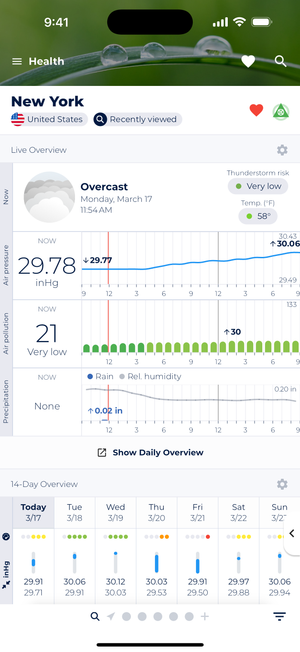

The Live Overview forecast available in the Health report shows a barometric pressure graph for the upcoming hours.
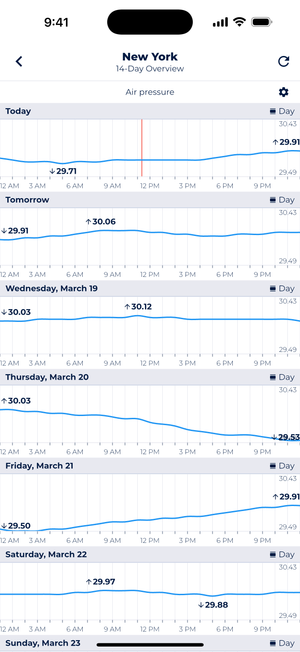
Barometric pressure graphs are available throughout the app, in this case as part of the 14-Day Overview.
Sonuby’s Live Overview displays a 24-hour barometric pressure graph right at the top of your screen. You can see at a glance:
This means when you check headache weather today, you get the full picture — not just a single number, but the entire pressure story for your day. Whether you’re monitoring your migraine forecast today or tracking longer-term patterns, the Live Overview gives you the insights you need.
Need to schedule important meetings or plan activities? Sonuby’s 14-Day Overview shows you barometric pressure patterns up to two weeks in advance.
You can:
The 14-Day Overview includes daily minimum and maximum pressure readings, so you can see not just what the pressure will be, but how much it will fluctuate each day — critical information for managing weather-sensitive conditions.

Tap on a day to see detailed hourly forecasts.
Daily pressure forecasts & more with Daily Overview.
The Health Report doesn’t just track pressure — it monitors all weather factors that affect headache sufferers:
Thunderstorm Risk: Get advance warning of approaching storms, which combine multiple headache triggers. Plan accordingly with schedule flexibility.
Temperature Tracking: See hourly temperature changes to identify cold fronts and rapid temperature drops that might trigger migraines.
Air Quality Data: Monitor air pollution levels, if you notice they affect how you feel.
UV Index: Track sun intensity for those whose migraines are triggered by bright light.
All of this data is presented in clear, easy-to-read graphs specifically designed for daily health management — not buried in weather forecast details. Your personalized headache forecast combines all these factors to give you the complete picture.
Everyone’s triggers are unique. Sonuby lets you customize exactly what you see:
This personalization means your migraine weather forecast shows exactly what matters to you — no more, no less.
Sonuby users with weather-sensitive conditions report several key benefits:
Planning with Your Doctor: Instead of waiting for headache symptoms to start, see pressure drops coming and plan your medication with your doctor.
Better Daily Planning: Schedule important meetings, workouts, or social activities on low-risk days. Keep demanding tasks flexible when trigger conditions are forecast.
Reduced Anxiety: Knowing what’s coming removes the uncertainty. You’re prepared rather than surprised by sudden weather-triggered headaches.
Pattern Recognition: Over time, you’ll identify your specific triggers and thresholds. Maybe you’re more sensitive to pressure drops in winter, or certain temperature ranges affect you more. This data is invaluable for working with your doctor.
Travel Planning: Check pressure forecasts for your destination before traveling. A quick check of your migraine forecast today before a trip can help you plan accordingly.
Sonuby Weather is free to download and provides global coverage. Whether you’re tracking your migraine forecast today in New York, monitoring air pressure in London, or checking headache weather in Tokyo, Sonuby has you covered.
The app is available on both iOS and Android, with all core health tracking features available in the free version. Premium features add additional customization options, but the essential barometric pressure tracking you need is always free. Get your personalized pressure forecast and start managing weather-triggered headaches more effectively.
Living with migraines or what feels like a sinus headache means weather isn’t just small talk — it’s a health factor you need to monitor. A migraine weather forecast transforms you from a passive victim of atmospheric changes into someone who can see weather-triggered headache days coming and prepare for them.
With Sonuby’s detailed barometric pressure tracking, 14-day forecasts, and health-focused interface, you finally have the tool you need to manage weather-sensitive conditions effectively. Check your pressure forecast, watch for sudden changes, and plan your days with confidence.
Your head might still predict storms — but now you’ll see them coming before your headache does.
Download Sonuby Weather today and start tracking your migraine forecast for free.
It may be, if the weather is changing quickly where you are. In one headache clinic study, about half of the migraine patients were sensitive to the weather [1], and studies link pressure drops [8], temperature changes [4], lightning [7] and, in Canada, warm chinook winds [10] to more attacks. Check today's hourly pressure and temperature graphs: a steady day makes weather a less likely trigger, a sharp drop or an approaching storm makes it worth considering.
There's no single level: in a Japanese study of 28 patients, migraines became more frequent around day-to-day pressure drops of more than 5 hPa (about 0.15 inHg). [8] In another, of 34 patients, attacks came most often when pressure fell 6–10 hPa below the standard 1013 hPa, to 1003–1007 hPa (about 29.6–29.7 inHg). [9] Both studies were small, so treat these as rough guides.
Why a drop in pressure sets off a headache isn't settled yet. One leading idea is that pressure changes may activate the trigeminal nerve, a key player in migraine pain. [2] Sensitivity also differs a lot from person to person: in one headache clinic study, about half of the migraine patients were sensitive to the weather and half weren't. [1]
30 inHg (about 1016 hPa) is slightly above average. Standard sea-level pressure is 29.92 inHg (1013.25 hPa), so readings above that lean high and readings below it lean low. [14] In one small migraine study, attacks came most often when pressure sat lower, at 1003–1007 hPa (about 29.6–29.7 inHg). [9]
The studies don't look at rain itself. Rain often comes with lower pressure, which a large emergency-department study linked to a small rise in headache risk [3], and a thunderstorm adds lightning, which is linked to more migraines. [7] Most headaches that feel like sinus headaches turn out to be migraine [12] [13], and in one study 83% of those people named weather changes as a trigger. [12]
You can't stop the weather, but you can see it coming. Watch the pressure forecast so you know when a drop is due, keep demanding plans flexible on those days, and keep in mind that hot, humid days make dehydration more likely [5], which is itself a migraine trigger for some people. [6] Talk to your doctor about how to handle the days your forecast flags; a forecast helps you plan, it doesn't treat the headache.
Yes. Weather apps can't predict your migraine, but they can predict the weather linked to it. A migraine weather app shows barometric pressure changes hours and days ahead so you can spot likely trigger days, and some add thunderstorm, temperature and humidity forecasts.
The best one shows pressure as an hourly graph for today and a trend for the coming days, not just a single number. Sonuby Weather's Health Report shows a 24-hour pressure graph, a 14-day pressure outlook, thunderstorm risk, temperature and air quality, and lets you switch between hPa and inHg. It's free on iOS and Android.
Resources:
[1] Prince, P. B., et al. (2004). The effect of weather on headache. Headache: The Journal of Head and Face Pain, 44(6), 596-602. https://doi.org/10.1111/j.1526-4610.2004.446008.x
[2] Kesserwani, H. (2021). Migraine Triggers: An Overview of the Pharmacology, Biochemistry, Atmospherics, and Their Effects on Neural Networks. Cureus, 13(4), e14243. https://doi.org/10.7759/cureus.14243
[3] Mukamal, K. J., et al. (2009). Weather and air pollution as triggers of severe headaches. Neurology, 72(10), 922-927. https://doi.org/10.1212/01.wnl.0000344152.56020.94
[4] Scheidt, J., et al. (2013). Influence of temperature changes on migraine occurrence in Germany. International Journal of Biometeorology, 57(4), 649-654. https://doi.org/10.1007/s00484-012-0582-2
[5] Heat and Cold Illness in Travelers, CDC Yellow Book
[6] Blau, J. N. (2005). Water deprivation: a new migraine precipitant. Headache: The Journal of Head and Face Pain, 45(6), 757-759. https://doi.org/10.1111/j.1526-4610.2005.05143_3.x
[7] Martin, G. V., et al. (2013). Lightning and its association with the frequency of headache in migraineurs: an observational cohort study. Cephalalgia, 33(6), 375-383. https://doi.org/10.1177/0333102412474502
[8] Kimoto, K., et al. (2011). Influence of barometric pressure in patients with migraine headache. Internal Medicine, 50(18), 1923-1928. https://doi.org/10.2169/internalmedicine.50.5640
[9] Okuma, H., et al. (2015). Examination of fluctuations in atmospheric pressure related to migraine. SpringerPlus, 4, 790. https://doi.org/10.1186/s40064-015-1592-4
[10] Cooke, L. J., et al. (2000). Chinook winds and migraine headache. Neurology, 54(2), 302-307. https://doi.org/10.1212/wnl.54.2.302
[11] Kelman, L. (2007). The triggers or precipitants of the acute migraine attack. Cephalalgia, 27(5), 394-402. https://doi.org/10.1111/j.1468-2982.2007.01303.x
[12] Eross, E., Dodick, D., & Eross, M. (2007). The Sinus, Allergy and Migraine Study (SAMS). Headache: The Journal of Head and Face Pain, 47(2), 213-224. https://doi.org/10.1111/j.1526-4610.2006.00688.x
[13] Schreiber, C. P., et al. (2004). Prevalence of migraine in patients with a history of self-reported or physician-diagnosed “sinus” headache. Archives of Internal Medicine, 164(16), 1769-1772. https://doi.org/10.1001/archinte.164.16.1769
[14] NOAA National Weather Service JetStream: Air Pressure. https://www.noaa.gov/jetstream/atmosphere/air-pressure
